
Clay Soil Stabilization
SOIL STABILIZATION
Clay bearing soils
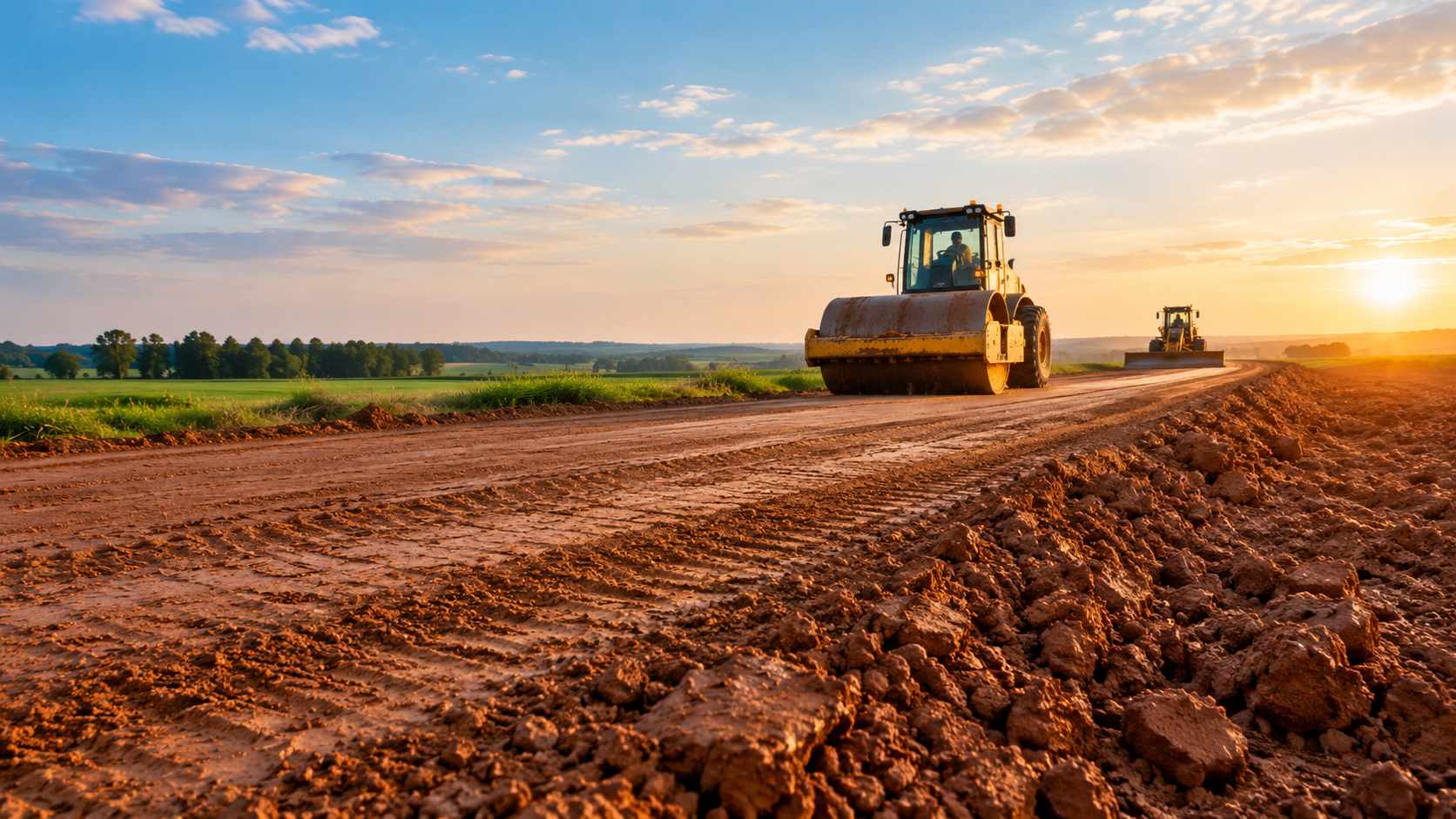
Claycrete II™ is a chemical soil stabilizer designed to treat the clay fraction of suitable soils — improving compaction, strength and resistance to moisture-related deterioration in roads, subgrades and infrastructure.
Instead of automatically removing and replacing marginal soil, Claycrete offers another approach: evaluate the existing material and determine whether it can be stabilized for use in your project.
DEFINITION
What is clay soil stabilization?
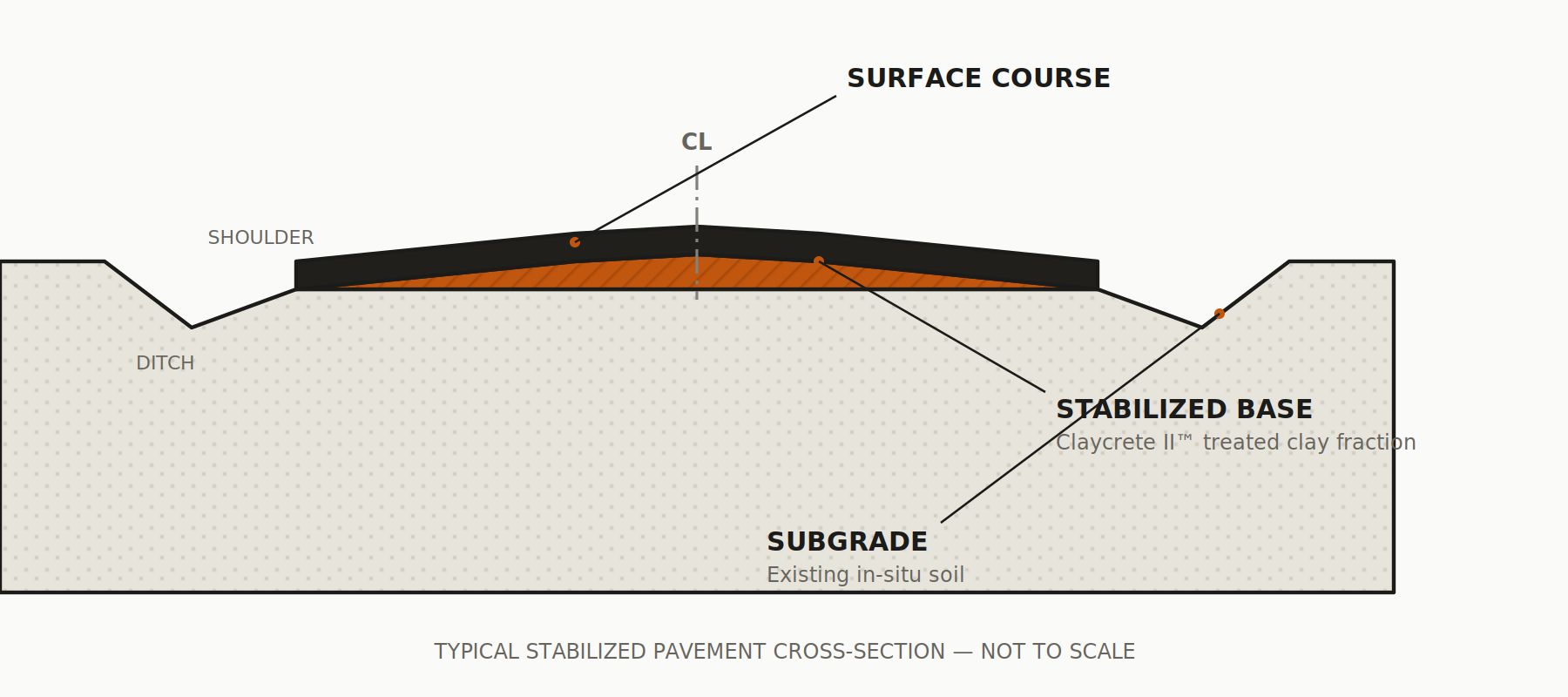
Clay soil stabilization is the process of improving the engineering properties of clay-bearing soils so they can perform more effectively in applications such as road construction, pavement bases, subgrades and other infrastructure.
Clay soils can change behavior as moisture conditions fluctuate. Depending on mineralogy, plasticity and other characteristics, some may shrink, swell, soften or lose strength when exposed to changing moisture.
Traditional approaches may include removing unsuitable soil, importing replacement material, mechanical blending, or using chemical stabilizers such as lime or cement. Claycrete II™ offers a chemical stabilization approach specifically designed to react with the clay fraction of suitable soils.
The treatment changes the charge of the clay fraction and reduces shrink-swell behavior while improving the density and strength of the treated material when compacted. Actual performance depends on the soil and project conditions.
RATIONAL
Why stabilize clay-bearing soil?
Clay-bearing soils are not automatically unsuitable for construction. In many cases, the challenge is understanding how the material behaves and whether its properties can be improved economically.
Improve soil strength
Stabilization can help improve the engineering performance of suitable clay-bearing soils used in road bases and subgrades.
Make better use of local materials
Where testing supports it, stabilizing existing soil may reduce the need to excavate and haul in replacement materials.
Address moisture-related movement
Some clay soils shrink or swell as moisture changes. Claycrete is designed to reduce these characteristics in suitable treated materials.
Support road & infrastructure work
Properly evaluated and constructed stabilized soils may be used in road bases, unsealed roads, haul roads and other engineered applications.
MECHANISM
How Claycrete II™ stabilizes clay soil
Claycrete II™ is a liquid chemical soil stabilizer developed to treat the clay fraction within suitable soil materials. Rather than relying on large quantities of cementitious material to bind the entire soil matrix, Claycrete's approach focuses on the clay portion of the mix.
Claycrete II™ changes the charge of the clay fraction, allowing treated particles to compact into a more tightly bonded structure with reduced voids. This results in improved density, strength and resistance to water ingress as intended benefits of the process.
How the stabilization process works
Evaluate the soil
Determine the soil's clay fraction, Plasticity Index (PI), Cation Exchange Capacity (CEC), and other relevant properties.
Determine suitability and treatment
Use test results and project requirements to establish whether Claycrete is appropriate and what treatment is needed.
Prepare and mix the material
Prepare the soil and incorporate Claycrete II™ and water according to the project-specific method.
Grade and compact
Shape and compact the treated material to the specified moisture content and density.
Verify performance
Use appropriate testing and quality control to assess the treated material against project requirements.
The key is soil-specific treatment. Claycrete is not a universal additive for every clay type or every construction condition.
COMPARISON
Claycrete vs. traditional stabilization methods
There are several ways to improve clay-bearing soils. The appropriate method depends on the soil's mineralogy, plasticity, moisture, engineering requirements, construction conditions and project economics.
| Method | Approach |
|---|---|
| Lime stabilization | Uses lime to modify and stabilize suitable clay soils. |
| Cement stabilization | Uses cementitious bonding to improve soil strength. |
| Mechanical stabilization | Blends soils or aggregates to achieve desired gradation and performance. |
| Excavation & replacement | Removes unsuitable material and replaces it with engineered fill. |
| Claycrete II™ | Chemical treatment designed to react with the clay fraction of suitable soils. |
Claycrete is an alternative to evaluate — not a universal replacement for lime, cement or other stabilization methods. Laboratory testing and engineering design should establish which approach meets the project's requirements.
FIRST STEP
Soil testing: where clay stabilization starts
The performance of a chemical soil stabilizer depends on the characteristics of the soil being treated. Claycrete Global identifies Cation Exchange Capacity (CEC) as an important indicator for evaluating Claycrete II™ suitability.
STANDARD PAVEMENT CALCULATION
CEC = Plasticity Index (PI) × Fines passing No. 200 sieve
Preferred range: CEC 50–400 — additional assessment recommended outside this range
| Soil property | Why it matters |
|---|---|
| Clay fraction / fines | Helps characterize the material available for treatment. |
| Plasticity Index (PI) | Indicates the range of moisture over which soil exhibits plastic behavior. |
| Cation Exchange Capacity (CEC) | Determines soil suitability for Claycrete. |
| California Bearing Ratio (CBR) | Assesses bearing strength for road and pavement applications. |
| Moisture content | Influences mixing and compaction. |
| Gradation | Helps assess the balance of fines and granular material. |
Before selecting a treatment, evaluate the soil characteristics and discuss the results with a Claycrete technical advisor.
USE CASES
Clay soil stabilization applications
Claycrete II™ is used in a range of pavement and soil stabilization applications where suitable clay-bearing materials are available.
Gravel & unsealed roads
Road bases & subgrades
Mining & haul roads
Stabilize suitable clay-bearing road materials to help improve strength, durability and resistance to moisture-related deterioration.
Evaluate existing soil for use in engineered pavement layers where improved bearing performance is required.
Agricultural & farm roads
Consider chemical stabilization for suitable mine access roads, quarry roads, and other heavy-traffic unsealed routes.
Airstrips & structural work
Assess whether local clay-bearing materials can be stabilized for farm access, grain transport and agricultural infrastructure.
Evaluate Claycrete for suitable soil-based pavement and structural applications subject to project-specific engineering requirements.
ECONOMICS
Reduce replacement costs by evaluating what you already have
Excavating unsuitable clay soil and importing replacement aggregate can involve significant material, transportation, equipment and labor costs. Chemical stabilization may offer another option when the existing soil is suitable and the treated material meets engineering requirements.
The potential economics depend on
Existing soil characteristics
Required treatment depth
Stabilizer application rate
Imported aggregate requirements
Haul distance and material cost
Equipment and labor
Drainage and road design
Required performance and maintenance
What would it cost to stabilize your clay soil?
Find out how your existing soil, project dimensions and treatment requirements may affect the cost of stabilization. Use Claycrete's Road Cost Estimator as a starting point, then work with the Claycrete team to evaluate your project.
-
The appropriate method depends on soil mineralogy, plasticity, moisture conditions, engineering requirements and project economics. Lime, cement, mechanical blending, excavation and replacement, and chemical stabilizers are among the available approaches. Soil testing helps determine which method is suitable.
-
A clay soil stabilizer is a material used to modify or improve the engineering properties of clay-bearing soil. Stabilizers may include lime, cement or specialized chemical products such as Claycrete II™, which is designed to react with the clay fraction of suitable soils.
-
Yes. Some clay-bearing soils can be used in road construction when their properties are appropriate or can be improved through stabilization and proper engineering design. Soil classification, CBR, moisture sensitivity, drainage and project requirements should be evaluated.
-
No universal stabilization treatment works equally well on every soil. Claycrete's suitability evaluation considers CEC and other soil and project characteristics. Claycrete Global recommends technical consultation and, where appropriate, small trials for materials with CEC values above its preferred range.
-
Cation Exchange Capacity (CEC) is a measure of a soil's capacity to hold and exchange positively charged ions. CEC as an important indicator in evaluating soils for Claycrete II™ treatment.
-
CBR (California Bearing Ratio) is an indicator of soil bearing strength used in road and pavement engineering. CEC (Cation Exchange Capacity) is a soil chemical property. CBR helps evaluate engineering performance, while we use CEC as part of the soil suitability assessment.
-
Yes. If suitable existing soil can be stabilized and reused, a project may reduce excavation, aggregate replacement and hauling requirements. Actual savings depend on the site, treatment design, construction costs and performance requirements.
-
Service life depends on the stabilizer, soil characteristics, construction quality, drainage, traffic and environmental conditions. Claycrete II™ is a long-term, one-time treatment, but project-specific design, verification and maintenance planning remain important.
-
Yes. Soil testing is a critical first step. Clay fraction, PI (Plasticity Index), PL (Plasticity Limit), LL (Liquid Limit, CEC, optimum moisture conent and other properties can help determine whether Claycrete II™ is appropriate and what treatment approach should be considered.
Frequently Asked Questions
GET STARTED
Your soil may be a resource — not a disposal problem
Before you excavate, replace or import expensive materials, evaluate whether your existing clay-bearing soil can be stabilized. Claycrete Global can help you understand your soil characteristics, evaluate Claycrete II™ suitability and determine the next steps for your project.
Start your clay soil stabilization project
Soil suitability evaluation
Treatment and application guidance
Project cost evaluation