
CLAYCRETE GLOBAL / PAVEMENT ENGINEERING
CBR Soil Stabilization
Measure how well your road material resists penetration, then test whether a treatment can meet the design requirement for your site.
01 / THE TEST
What does California Bearing Ratio measure?
California Bearing Ratio (CBR) compares the stress needed to push a standard piston into a prepared specimen with a reference stress at the same penetration. It is a percentage used in empirical pavement design and material specifications for subgrades, subbases and bases.
CBR depends on how the sample is prepared and conditioned. A result is meaningful alongside its test method, moisture, dry density, surcharge and soaking history. The pavement designer selects the design value and acceptance criteria for the layer, traffic, climate and drainage.
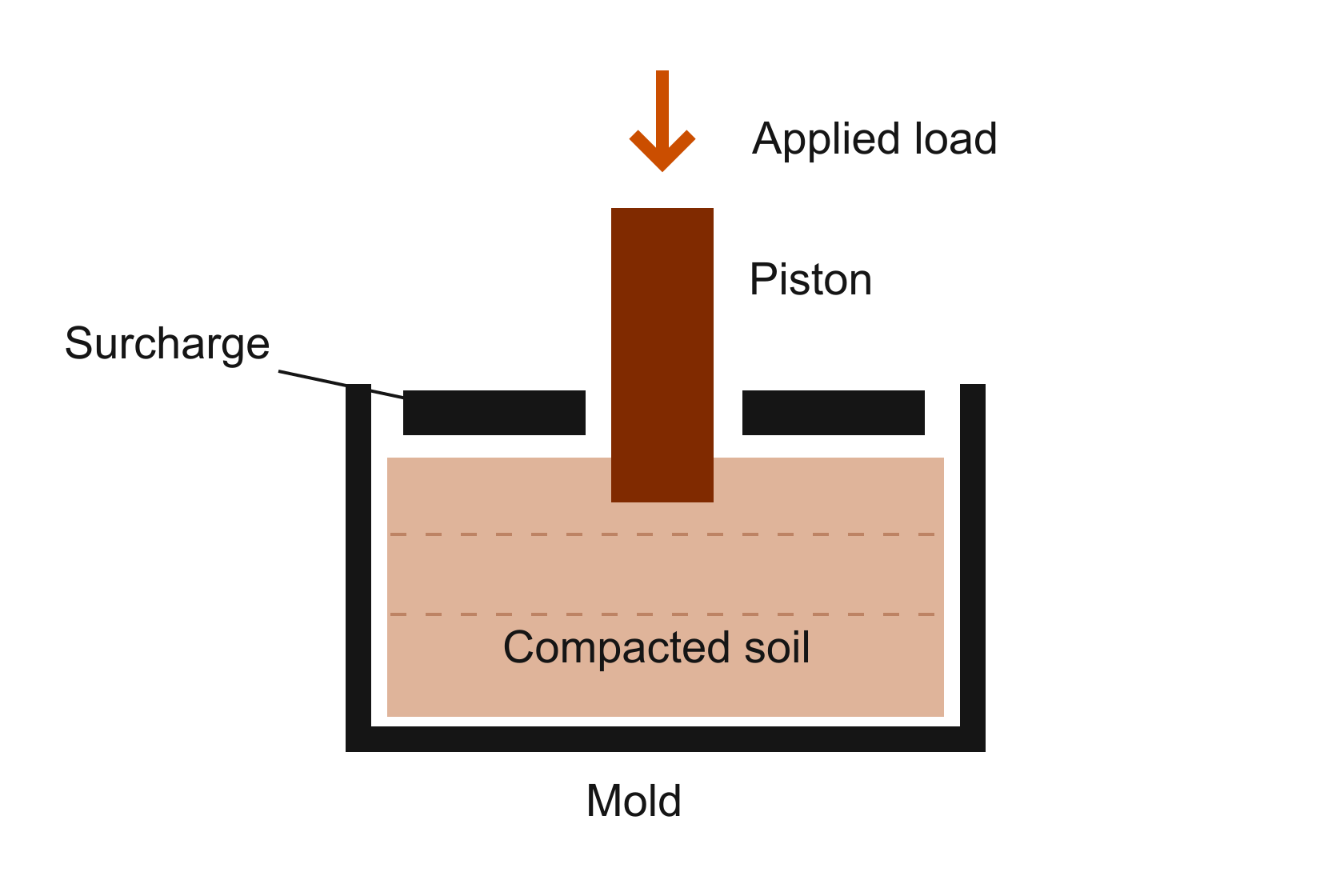
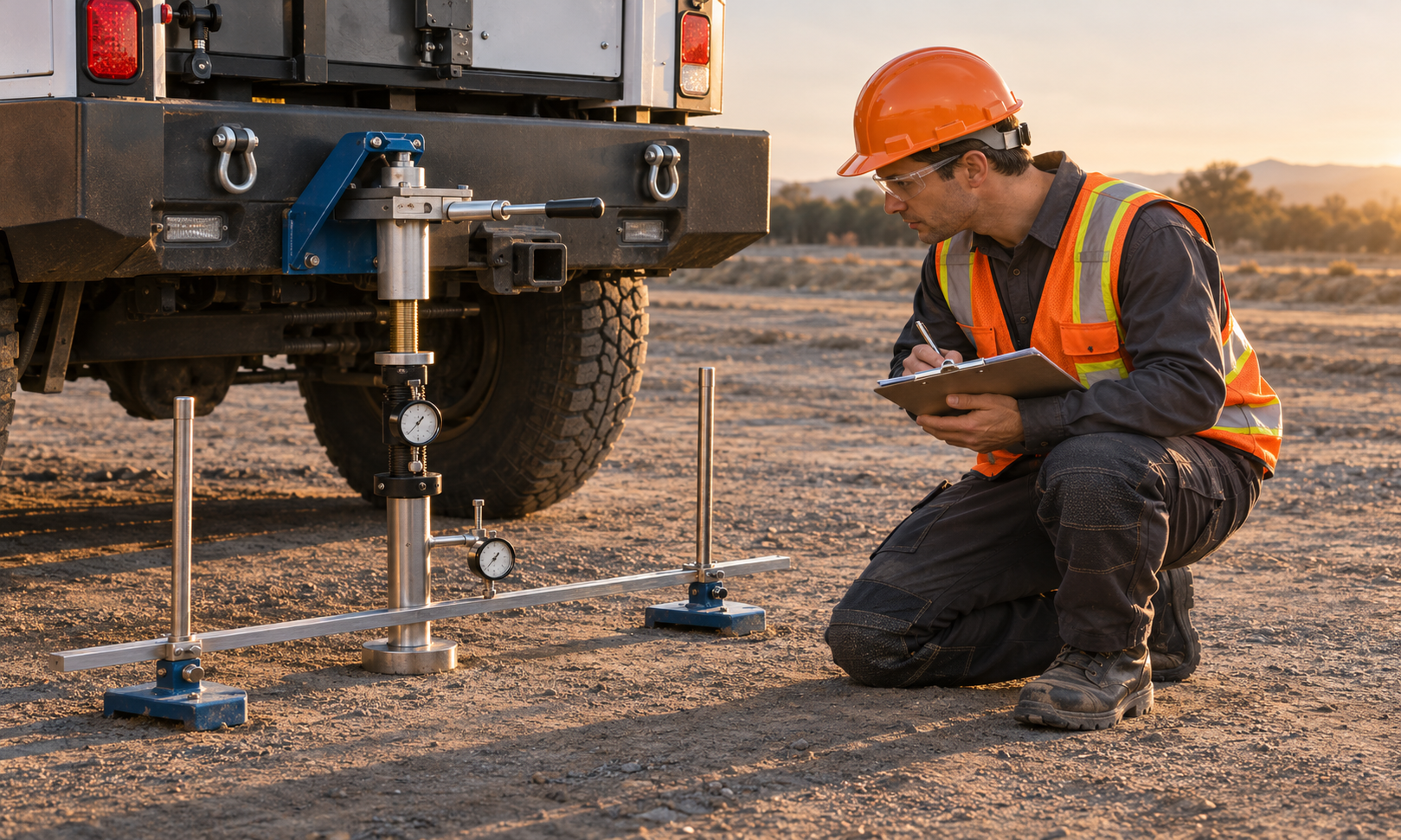
Laboratory penetration test schematic. The piston presses into a compacted specimen while surcharge weights sit around it.
Method references: FHWA pavement geotechnical guidance and AASHTO re:source laboratory instructions.
1. Sample the layer. Identify the soil unit and depth. Take representative samples from changes in material and from weak or wet areas.
2. Prepare the specimens. Specify ASTM D1883 or AASHTO T 193 as applicable. Set molding moisture and density using the project compaction reference, and specify surcharge and conditioning.
3. Condition and penetrate. Where specified, soak under surcharge, typically for 96 hours under common laboratory procedures, and record swell as required. Then apply the piston at the prescribed rate and record the load–penetration curve.
4. Interpret the curve. Correct the origin where the test method calls for it. Compare corrected stresses at the nominal 0.1 and 0.2 in. penetrations (about 2.5 and 5 mm) with 1,000 and 1,500 psi respectively. The shallower result normally governs. If the deeper result is higher, follow the method's repeat-test rule before reporting it.
02 / CALCULATOR
Compare untreated and treated CBR
Use the reported CBR values from comparable laboratory tests. The calculator shows the change in percentage points, the relative change from baseline, and the treated result’s margin against an optional target.
Compare samples from the same soil unit at the specified molding moisture and density, with matching test conditioning. Record how the treated specimens were mixed and aged. A margin against the entered target is an arithmetic comparison. Project acceptance also depends on sampling and the full specification.
Compare untreated and treated CBR
Enter the California Bearing Ratio (CBR) reported for untreated and treated specimens tested under comparable conditions. Add a project target to see how far the treated result is above or below it.
03 / MATERIAL SELECTION
Evaluate Claycrete II™ on compatible clay-bearing soil
Claycrete II™ is a chemical stabilizer intended for suitable clay-bearing materials. Low CBR can justify investigation, but the cause may be excess water, low density, unsuitable fill or a weak underlying layer. Establish the cause and assess the soil before choosing a treatment.
Characterize the material. Review grading, fines passing the No. 200 sieve, clay-size fraction, Atterberg limits, shrink or swell potential and the moisture–density relationship. Fines include silt as well as clay. Discuss clay mineralogy and measured cation exchange capacity (CEC) where relevant to compatibility.
Set a baseline and a target. Agree the governing test method, sampling plan, conditioning, reference compaction and design CBR with the project engineer. Consider drainage, seasonal wetting and the layer’s function in the pavement.
Run matched laboratory trials. Use representative untreated controls and treated specimens. Agree candidate dosage, mixing procedure and specimen age with the technical team. Record density, moisture and swell alongside CBR, and use replicate specimens where the test plan calls for them.
Verify a field trial. Check mixing depth and uniformity, application rate, moisture and field density. Compare the finished material against the approved acceptance plan, including any specified durability or moisture-sensitivity tests, before extending treatment.
Address water and variability. Provide drainage and protect the prepared layer before covering it. Where the material is incompatible or trial results fall short, evaluate blending, replacement, drainage improvements or other stabilization methods against the same project requirements.
04 / FAQs
Questions about CBR and soil stabilization
-
The required CBR depends on the pavement design method, traffic, moisture regime and local specification. Use the project’s specified value and test conditions.
-
A soaked CBR measures penetration resistance after specified immersion and surcharge. An unsoaked CBR reflects the specimen at the specified test moisture without immersion. Compare results within the same conditioning protocol.
-
Claycrete II™ is intended for suitable clay-bearing soils. Test the proposed treatment against an untreated control under comparable conditions to determine the response for your material.
-
CBR measures relative penetration resistance. CEC describes a soil’s capacity to exchange positively charged ions and can help characterize compatibility. Each test answers a different question.
-
A verified design CBR may affect thickness in a design method that uses it. The pavement designer must also assess traffic, drainage, layer properties and applicable minimum thickness requirements.
NEXT STEP / SOIL EVALUATION
Bring your test results to the treatment discussion
Share the project location, pavement layer, traffic, soil classification, moisture–density data, untreated CBR and design target with Claycrete Global.